The European Round Table of Industrialists was born out of a growing preoccupation with the state of the European economy in the early 1980s. Frequently diagnosed as “eurosclerosis”, the symptoms were an evident lack of dynamism, innovation and competitiveness in comparison with Japan and the United States. European markets, with the exception of agriculture, were still national, despite the Single Market objective set by the Treaty of Rome in 1957. Economies of scale were very hard to achieve and the burden of red tape was stultifying.
Fear of the consequences spurred a group of 17 businessmen to come together in Volvo's boardroom to launch the European Round Table of Industrialists in Paris on 6-7 April 1983. They sought consciously to create an organisation better able than others to wake up governments to the parlous state of the European economy.
Spearheading the initiative was Pehr Gyllenhammar, then chief executive of Volvo. His readiness to speak out to the press in favour of policy remedies for Europe’s structural problems encouraged other senior businessmen to join him - notably Wisse Dekker of Philips and Umberto Agnelli of Fiat. Their backing helped to secure the participation of other high-calibre, pro-European industrialists ready to support the idea that Europe needed to “break out“ of its current stasis and embark on a massive modernisation of its manufacturing base.
In Brussels, the Pehr Gyllenhammar initiative was watched with some interest at the European Commission (EC), where the Commissioner for Industry and the Single Market, Etienne Davignon, had earlier challenged industry to produce an initiative, posing the simple question: “whom do I call when I want to speak to European Industry?”
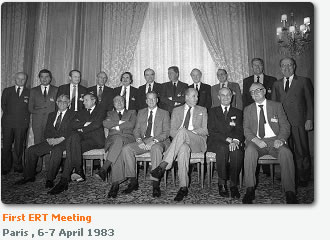 |
From left to right (top) :
Karl Beurle (Thyssen), Carlo De Benedetti (Olivetti), Curt Nicolin (ASEA), Harry Gray (United Technologies), John Harvey - Jones (ICI), Wolfgang Seelig (Siemens), Umberto Agnelli (Fiat), Peter Baxendell (Shell), Olivier Lecerf (Lafarge Coppée), José Bidegain (Cie de St Gobain), Wisse Dekker (Philips).
From left to right (bottom) :
Antoine Riboud (BSN), Bernard Hanon (Renault), François-Xavier Ortoli (EC), Pehr G. Gyllenhammar (Volvo), Etienne Davignon (EC), Louis von Planta (Ciba-Geigy), Helmut Maucher (Nestlé).
|
Etienne Davignon and his colleague Francois-Xavier Ortoli, Commissioner for Economic and Monetary Affairs, attended the later stages of the April founding meeting in Paris. It was the occasion for a great deal of lively debate and the first airing of many of the ideas and concerns that were to preoccupy ERT for the coming 20 years: high costs and low profits, fragmentation of the European market and excessive interference by governments, and the fundamental need to maintain and rebuild an industrial base in Europe across a broad strategic front, from new technologies to telecommunications. The discussion was sufficiently fruitful to convince those present that it was worth going ahead, and also to attract the interest of the Financial Times.
The organisation, charter and financial arrangements for ERT were agreed at a second meeting of Members (afterwards always referred to as "Plenary Sessions”) on 1 June 1983 in Amsterdam. The overarching objective would be to promote competition and competitiveness on a continental scale.
Volvo was charged with setting up a small Secretariat inside one of its Paris-based divisions. In 1985 ERT appointed its first full-time Secretary General, Peter Ekenger, and hired an office in Paris.
